
La biblioteca di Calvino
Calvino's library
When Elena received the letter that to her informed the assignment of the scholarship of study, not she believed her own own eyes. She had requested almost out of superstition, convinced that she would not would not ever choose her, and instead now she was been admitted to the archive private of one of the most great writers of the twentieth century.
The archive itself was located in a building from the seventeenth century of the center of Rome, on a street narrow that no tourist would ever find. One climbed a staircase of marble worn, all the way to the third floor, where a door of wood dark did not bear any plate. A bell of brass oxidized, a voice that answered only with monosyllables, and the ritual was complete.

Read it with audio, tap any word, keep the ones you want to remember.
10 minutes a day free · no card needed
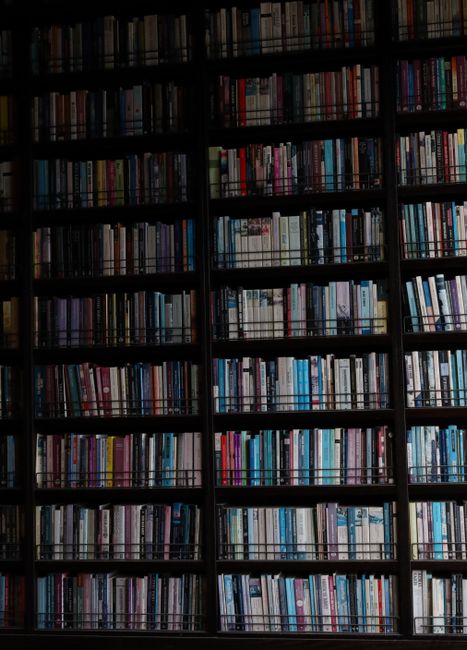
Inside, the time seemed to have stopped. The walls were covered with shelves very tall, loaded with volumes bound in leather, files blackened by time, boxes of cardboard which no one seemed to have opened for decades. A light oblique filtered from the shutters half-closed, revealing the dust that danced slowly in the air. Elena held back her breath.
The custodian, an old man elderly and very thin who to her made a sign to follow him, did not open his mouth if not to show her the desk where she would be assigned. Her rules, he explained finally, were simple: no photographing, no transcribing entire pages, no leaving the room with documents original. She would be able to read, take notes, question herself. Nothing more more.
The papers to her were delivered in a box of cardboard rough, on which someone had written in pencil: « Notebooks unpublished — cities imaginary ». She opened the first notebook with infinite caution, as if if the pages might go into dust at the first touch.
The handwriting was minute, slanted, rushing. The author in it had noted, over thirty years of work, the descriptions of cities that did not exist: cities suspended between two skies, cities made only of mirrors, cities that themselves rebuilt every night with stones different. Only a dozen of these fantasies had made it to the his books printed; all the others lay there, handwritten, unfinished, awaiting wait of someone.
Elena worked every day for three months. She arrived at nine, left at seven, and returned to the house where she rented in a studio near to Termini, where she ate something of cold, read her her notes, and herself fell asleep often dreaming the cities that she had read during the day. They began to populate her her dreams, these cities impossible.
There was one city, in particular, that her returned to to mind more often than the others. It was called Ofelia, and was inhabited only by women who had lost someone. The houses were built one on top of the other as more that new inhabitants arrived, because in Ofelia no one ever left ever away. The women watched the trains pass at the station, but none boarded ever.
One evening, rereading one of the last pages, Elena discovered something that her made tremble her hands. There was a note, written in pencil red and dated just two weeks before of his death of the writer: « If someone were to read these pages, let them know that Ofelia exists. It is not on any map, but it exists. I saw it once time, many years ago ».
Elena closed again the notebook, her heart which her beat in her throat. She got up, left the archive without saying goodbye, went down in a run the stairs of marble. When she reached the street, the sky of Rome was turning purple, and the swallows cut through the air in spirals. She walked for a long time, without a destination precise, until she found herself in front of the Termini station, watching the trains depart for cities far away.